The Bowman Case
English · Español · Français · Italiano · 中文 · Tiếng Việt · Tagalog
Thomas Alan Bowman, Sr. did everything his country asked. This page is the documented record of what his country did back — told in dates, case numbers, and the VA's own files, by the son who carried the case.
The service, and the promise
He was not drafted. He volunteered — twice. Thomas Alan Bowman, Sr., 84, enlisted in the United States Navy on February 25, 1960, and when that enlistment ran out he signed again — re-enlisting on February 20, 1964, with the war in Vietnam escalating — for two enlistments totaling 9 years, 11 months and 16 days of active service. (His DD-214 prints those numbers; so does the VA’s own rating decision of September 4, 2024, which lists his service as February 25, 1960 – February 19, 1964 and February 20, 1964 – February 10, 1970.) He was on active duty through the Cuban Missile Crisis of October 1962, in his first enlistment. His final period of service was anchored in Da Nang harbor, December 1969 – February 1970, on salvage operations — the anchoring documented in his Agent Orange Registry exam. Radioman Second Class (RM2), USS Arikara (ATF-98), honorable discharge, Vietnam era. He is rated 100% service-connected (his individual ratings add to 330%) and has received Special Monthly Compensation since October 2022. He is a widower; his wife, Julieanne Bowman, died on August 27, 2019. His son’s verdict on everything that follows is plain, and it is the reason this page exists: a man who volunteered twice, his son says, “has been betrayed by his country.”
His son, Thomas Bowman, Jr., holds his father’s Durable Power of Attorney and Health Care Surrogate designation, is his registered VA Family Caregiver, and is the sole Personal Representative under his father’s will. Tom is not a veteran. He has run this case essentially alone for about ten months.
The promise made to men like Thomas Bowman, Sr. is simple: serve, and when you can no longer stand on your own, the Department of Veterans Affairs stands behind you. What follows is what standing behind him looked like.
Timeline
| Date | What happened |
|---|---|
| 1960–1970 | U.S. Navy service — volunteered twice: enlisted Feb 25, 1960; re-enlisted Feb 20, 1964. Two enlistments, 9 years 11 months 16 days total active service. On active duty through the Cuban Missile Crisis (Oct 1962); final period anchored in Da Nang harbor, Dec 1969 – Feb 1970, salvage operations. RM2, USS Arikara (ATF-98), honorable discharge. |
| Dec 1969 – Feb 1970 | Anchored in Da Nang harbor, Vietnam, on salvage operations offshore — the exposure window recorded in the VA’s own Agent Orange Registry examination (Sep 12, 2019). |
| Feb 1, 2003 | VA disability compensation finally begins: $201 a month — thirty-three years after he came home. |
| Dec 1, 2015 | The first substantial increase in his compensation: $1,334.71 a month (per the VA’s own payment record). |
| Oct 1, 2022 | Special Monthly Compensation begins: $3,847.97 a month. After half a century, the real money arrives — dated by the VA’s own payment table to this month. |
| Oct 14, 2022 | Prostate biopsy: high-risk prostate cancer, Gleason score 9 (5+4) — the PSA of record was 28.1 (July 5, 2022); a September 12, 2022 draw read 20.1. A scan on Nov 11, 2022 shows the cancer has spread to his bones. The VA rates the cancer itself service-connected at 100% — its own note of Jan 9, 2023 lists among his rated disabilities: “NEOPLASM, MALIGNANT, GENITOURINARY (100%-SC).” |
| Dec 2023 | Compensation reaches $4,316.59 a month — in time for hospice, not for a life. |
| Jul 15, 2024 | His son registers as his VA Family Caregiver through the Orlando VA Caregiver Support Program — in the general program (PGCSS), the unpaid tier. |
| Dec 7, 2025 | Gallbladder surgery (cholecystectomy) at AdventHealth New Smyrna Beach, Dr. Tara Beth Wilson. The surgery leaves a gallbladder remnant with stones inside him (VA diagnosis K91.86). The operative report has never been furnished to the family, and no record the family holds shows the VA’s own surgeons received it. |
| Mar 11, 2026 | VA General Surgery documents that they “still strongly feel” advanced endoscopy is needed and recommend transfer. GI overrules. He is discharged into the gap — repeatedly. In the months that follow he is hospitalized roughly nine to eleven times, with two hypotensive collapses. |
| Feb 8–10, 2026 | AdventHealth Daytona Beach admission for intractable epigastric pain. The chart’s own words, uncompressed: the CT read “Redemonstration of partial cholecystectomy and multiple residual cholelithiasis” — stones in the gallbladder remnant — and the MRCP performed February 8 reported “No biliary stones or obstruction” and a “stable solid liver lesion in the left lobe, possibly a hepatic adenoma.” Both documents stand; the stones were in the remnant. |
| Mar 2026 | VA surgeons document on March 11 that advanced endoscopy is still strongly needed and recommend transfer. The consult that follows (#9247778) produces five months of scheduling — appointments created, rebooked, cancelled — ending in a consultation booked for August 28, 2026. No record in the family’s hands shows the recommended SpyGlass cholangioscopy performed; an upper endoscopic ultrasound was performed on August 28, 2026, and it was not the ordered procedure. The March 11 recommendation is never carried out. |
| Jul 23, 2026 | Tom asks in writing for help placing his father, and for the caregiver supports the VA advertises: PCAFC (Form 10-10CG), Aid & Attendance (Form 21-2680), a HISA home-access grant, respite care. |
| Jul 25, 2026 | Tom resends the placement inquiry marked urgent — his father is hospitalized with GI bleeding — and asks the VA to correct the dependency record that still names his dead mother as caretaker. |
| Jul 27, 2026 | A Blue Button report pulled through the family’s sign-in returns the son’s date of birth and email, “Service connected percentage: 0,” and no military service at all — for a 100% service-connected veteran. See the exhibit below. |
| Jul 29, 2026 | The VA confirms it: Julieanne Bowman, dead since August 27, 2019, is still his caretaker of record. Nothing was ever routed to the son who was actually doing the work. |
| Aug 7, 2026 | His father leaves AdventHealth against medical advice while the family’s second discharge appeal is still pending — and goes home without his insulin; he is an insulin-dependent diabetic, and the family’s position is that he lacked the capacity to make that choice. Tom reports a suicide risk and requests an involuntary examination under Florida §394.463; sheriff’s deputies reach his father, who tells them he does not need his medication. |
| Aug 12, 2026 | At midnight, Tom drives his father to the Shands emergency room in Gainesville himself — because that was the transport available. |
| Aug 14–24, 2026 | Admitted to Beach Street Health & Rehabilitation Center from Shands (face sheet: Humana Medicare Advantage; FULL CODE). Beach Street’s own therapy notes chart his gait across the stay — ~60 ft (Aug 20) → ~150 ft (Aug 21) → ~100 ft (Aug 24), the last of them fatiguing — and its records disagree on his insulin inside a single chart production: the Shands ED home-medication list shows Lantus 80 units nightly; Beach Street’s orders ran glargine 40 units. |
| Aug 28, 2026 | The consultation date the VA’s account ends at: booked at AdventHealth’s Center for Interventional Endoscopy (08:30; transport booked and NPO ordered in Beach Street’s own chart). No record in the family’s hands shows the March 11 recommended SpyGlass — the completion evaluation — ever performed; the August 28 encounter produced an upper endoscopic ultrasound, not the SpyGlass. |
| Aug 24–25, 2026 | A chance, face-to-face meeting with Alan Hubert, who runs admissions at Emory Bennett. Hubert visits Tom’s father the next day and submits the admissions packet himself. |
| Aug 27–28, 2026 | After the Secretary’s Rapid Response team asks for the case by email, Tom sends the full case to customercare@va.gov. On Aug 28 the Office of Client Relations acknowledges it, says it was forwarded to VHA leadership — and states that “this email address does not accept replies.” In the seven weeks that followed, no one from VHA followed up. |
| Sep 2026 | His father reaches the Emory L. Bennett Veterans Nursing Home — roughly six weeks after a 100% service-connected veteran’s family first asked for placement help. |
| Oct 11, 2026 | His father tells his son he wants to die and be with his mother. |
What the service left in him
The VA has never disputed that Thomas Bowman, Sr. was exposed. It documented the exposure itself. His Agent Orange Registry examination (September 12, 2019) records his exposure period as December 1969 to February 1970 — “anchored in Denang harbor. Involved in salvage operations off shore” — occupation: radioman. A VA Toxic Exposure Screening records Agent Orange as the exposure; his problem list carries “Exposure to potentially hazardous substance.”
What the record shows after that exposure:
- Prostate cancer, diagnosed October–November 2022, Gleason 9, metastatic to bone — rated by the VA itself at 100% service-connected, treated with hormone therapy (Lupron, Xtandi) through a community oncologist, with opioids charted “for cancer related pain.”
- Pulmonary fibrosis with honeycombing — lungs scarred beyond repair.
- Pansinusitis — his sinuses fully opacified on a VA scan as early as 2009; allergic rhinitis active in his chart for years.
- Tinnitus, rated 10% service-connected; impaired hearing, rated 0% service-connected.
- Asthma, skin cancers, and the long list that fills a 100% rating at a combined total whose individual ratings add to 330%.
He came home in 1970. He was first compensated in 2003 — at $201 a month. The substantial money, and the Special Monthly Compensation, arrived in October 2022, the same month a biopsy confirmed the cancer that is now killing him. His wife did not live to see any of it: Julieanne Bowman died in 2019.
The exhibit: a veteran the VA’s own system cannot see
Blue Button is the VA’s official health-records download — the document the VA itself generates about a veteran. On July 27, 2026, a Blue Button report pulled through the family’s sign-in returned his son’s date of birth and email, “Service connected percentage: 0,” and no military service at all. The family’s account is that the profile had been created under the son’s identity while he fought for caregiver access; the veteran’s own report, pulled August 24, 2026, shows 100%. The VA has never explained how its sign-in produced a second profile, or confirmed it is fixed. Here is what that crossed report said about a 100% service-connected Navy veteran:
- Date of birth: his son’s — not his.
- Email address: his son’s — not his.
- “Service connected percentage: 0” — for a man rated 100%, with Special Monthly Compensation since 2022.
- “Military Service: No data was found” — for ten years of Navy service.
- VA.gov separately told this 100%-rated veteran: “We don’t have a combined disability rating on file for you.”
And while the live record belonged to the wrong man, the VA’s caretaker of record was a woman seven years dead — confirmed by the VA on July 29, 2026 — while the registered caregiver actually doing the work received nothing, and was routed nothing.
This is not a paperwork typo. Wrong identity data is how a March consult never gets scheduled, how authorizations vanish, how a VA refuses to speak to the son holding the power of attorney. One conflated record, upstream of everything — and every failure downstream of it lands on the family.
Any family can check for this in about five minutes. Take the Blue Button test →
The label that followed him
Before Bennett, there was the pain — metastatic cancer pain, in a man whose own chart carried opioids “for cancer related pain.” By the family’s account, he was taken to the Orlando VA at Lake Nona three times. On the third visit, staff drew his blood, left it on the table, and never ran it — because he had been there some ten days earlier. A doctor there labeled him “drug seeking” — the word as the family carries it; the phrase itself appears nowhere in the pulled VA text, and the visit notes that would settle it have never been produced. From that day, the family says, every fight for his pain control was a fight against that word.
Then came Gainesville. By his son’s account, he drove his father through the night and reached the Gainesville VA at about 2 AM — to find it closed to him. Next door, UF Health Shands took him in. He arrived unable to walk, unable to get up, disoriented; three staff members moved him from the car onto a stretcher. By the family’s account, the label had arrived before he did — it sat in Shands’ notes too. By his family’s account, he lay in pain for hours without relief; the chart Shands produced later shows pregabalin newly prescribed and an escalated oxycodone regimen on paper. He was held under observation status — never admitted — and the plan was to discharge him to his son in the parking lot. Shands’ own production, obtained later, documents the status in the hospital’s words: “Placed in observation on 8/12/2026 at 9:06 PM” — the observation completed the following afternoon, the stay closed out to a nursing facility, and the Medicare Important Message about his discharge rights recorded as not applicable — because the stay was observation.
His son refused to take him. He said he would file with Medicare to keep his father there, and was told he could not — the observation status saw to that. He left his father there anyway, and the hospital found its own doctor, who filed the rehabilitation paperwork. The family was then made to pay for the medical transport from Gainesville back to Daytona Beach — to Beach Street Rehabilitation, the facility he would leave, weeks later, for Bennett.
The family ledger
The VA’s failures did not make the work disappear. They transferred it — unpaid, unrecognized, and without choice — to the family.
- Registered caregiver since July 15, 2024 — enrolled through the Orlando VA’s Caregiver Support Program, in the general (PGCSS) tier. The unpaid tier.
- Asked in writing, July 23 and July 25, 2026, for the supports the VA advertises to families like his: the comprehensive caregiver program (PCAFC, Form 10-10CG), Special Monthly Compensation — Aid & Attendance (21-2680), a HISA home-access grant, respite care, wheelchairs. The family’s archive contains no approval of any of them.
- The one clean win: an 18-foot aluminum ramp. After filing again and again, the VA came out and delivered an 18-foot aluminum ramp for the family home. His son calls it his pride and joy — “the only major battle that I won.” A manual wheelchair and a walker were provided as well, at the Orlando VA (Lake Nona). The power chair those same halls approved is another story:
- Power wheelchair (a Hoveround): requested in early 2026 — and never delivered. The process began with a flyer handed to the family at the Orlando VA (Lake Nona); after months of waiting, the evaluation appointment finally came in April 2026 — and by May, his son was already on video, in public, asking why a veteran’s chair was taking so long. By the family’s account, the VA approved the chair, and a vehicle lift and hitch with it. His own VA chart, after the April 2026 evaluation, carried the VA’s patient-education text (CPT 97535): “Your scooter/power chair will be ordered within the next week [through] the Prosthetics Department of the VA… It will take 2-3 months with orders for power scooters and high end power wheelchairs…” — and, for the lift: “If you need a lift for your vehicle, it will be installed when the scooter/power wheelchair is delivered.” Nothing was ever delivered or installed: no chair at home, no chair at either facility, nearly ten months on. And the approval correspondence was addressed to Julieanne Bowman — his wife, dead since August 27, 2019 — because the VA still carries her as the contact of record. A 100% service-connected man got his wheelchair approved on paper, in a letter sent to his dead wife, and the chair never came.
- His teeth. Most of his teeth were already missing by May 2024; the VA’s plan covered four extractions. In his own words in the chart (September 27, 2024), he went private because he ‘could not wait.’ What followed was a years-long fight through Lifetime Dentistry, a Community Care vendor the family would file extensive complaints against: a temporary denture, a permanent top denture that never worked, a return to the temporary — that is what he finished on. Across the fight he paid some $15,000 out of his own pocket. The fight itself is an exhibit: when his son confronted the dentist, she stopped everything to meet with him and produced a ream to a ream and a half of paper — 500 to 750 pages — that she said was her VA correspondence on cases like his: denials, demands, delays. When he called the VA’s own dental contact, she told him the opposite — nothing but problems with Lifetime Dentistry “not following the basic rules.” His son’s verdict stands as the family’s: he does not know which of them was lying. He knows his father had no working teeth.
- Diabetes — the charges that stand on documents. His basal-insulin figures never agree anywhere in his own records: 60 units on his VA medication lists (a dose the VA itself flagged as ‘unusually high’), 5 units at AdventHealth — and, inside a single August 2026 hospital chart production, a Shands ED home-medication list showing Lantus 80 units nightly against Beach Street orders for glargine 40 units. And on August 7, 2026, he left against medical advice, mid-appeal, and went home without his insulin — the family’s position is that he lacked the capacity to make that choice. (This page previously repeated the family’s filing that an A1c was ‘ordered three times, never drawn.’ The VA chart contains drawn A1c results; that claim is withdrawn — see Corrections, below.)
- In the worst month of this case, on his account, Tom worked 75 to 85 hours a week on his father’s care.
- The case archive holds 141 emails from July 23 to October 12, 2026 (68 of them sent from the family’s addresses, including the caregiver-assistance system’s own automated messages) — one slice of the expanded archive — 335 messages across every channel the family fought from. The full archive is preserved and citable in the family’s case file.
- Compensation received for two years of full-time caregiving: zero.
How he actually got into Bennett
Let the record be exact about the one thing that worked, because it was not the system.
None of the case numbers did it. Not the Senate casework, not the VA Hotline, not AskVA, not the patient advocates, not the oversight complaints, and not the two hundred emails. What got Thomas Bowman, Sr. into Emory Bennett was an accident: his son ended up face to face with Alan Hubert, the man running admissions at Bennett, laid his father’s condition on him in person — and Hubert visited the father the next day and put the packet through himself.
One man, reached by chance, did in days what the entire department would not do in six weeks. That is not a system working. That is a system rescued by luck and one decent human being — and a father should not need luck to receive what he was promised in writing.
Ninety days
Measure the decline the way his family has lived it: in ninety days. In mid-July 2026, Thomas Bowman, Sr. was at home — diminished, in pain, but fighting, with a son asking the VA for the supports that might have kept him there. Then, in ninety days: the placement requests and the urgent resend; the hospitalizations and the collapses; a mid-appeal departure without his insulin; a midnight drive to Gainesville; a night he could not be found; a veterans home reached by accident in September; and by October a man who can barely stand, who will not eat, who has told his son he wants to die and be with his mother. Ninety days from a home to a nursing-home bed.
And let the record be exact about how hard this family knocked, because it was not only letters. They went in person — to the Orlando VA, three times, and through the night to Gainesville. They called the White House VA Hotline in Washington and received a case number and an acknowledgment, and no callback. They engaged a United States senator’s casework office, the Secretary’s own correspondence office, the Inspector General, their congressman, the sheriff, and the state. Every door the VA instructs a family to knock on, this family knocked on — in writing, in person, and by phone to Washington itself. The doors are listed in the table below, with what came back through each of them.
Every office contacted — and what came back
| Office / channel | Reference | What came back |
|---|---|---|
| VA Community Care (Orlando VAMC) | Consult #9247778 | Authorized March 2026. Appointment booked for August 28, 2026; the March 11, 2026 recommendation was never carried out. |
| Secretary’s office / Office of Client Relations (Rapid Response referral) | Full case emailed Aug 27, 2026 | Acknowledged Aug 28, 2026: forwarded to VHA leadership; the address “does not accept replies.” No VHA follow-up in the seven weeks that followed. The Department’s one later reply arrived Oct 16, 2026 — in another family mailbox — stating that its records indicate Bret Hirsch, LCSW contacted Tom on Sept 11, 2026 and “will be your point of contact.” It carried no Executive Correspondence tracking number, did not address consult #9247778, the conflated record, or the caregiver accounting, and came from an address that does not accept replies. The family’s record shows no substantive follow-up from Mr. Hirsch. Recorded in full at The Correspondence. The same office had acknowledged an earlier family concern in January 2026 under SF 14403709, promising VHA leadership follow-up; the family’s reply of January 8, 2026 came back undeliverable — the address does not accept replies. |
| White House VA Hotline | Case 15115179 | “Concern Received,” Aug 5, 2026; routed to patient advocacy. |
| Veterans Experience Office — the survey | “VA Scheduling Survey – 2 minutes” (OMB 2900-0876) | The one VA system in this case that never missed. Invitations and reminders arrived Aug 14, Aug 21, Oct 9 and Oct 16, 2026 — addressed to the veteran, his middle name misspelled, at his son’s email address — asking the family to rate the scheduling of his appointments. His defining recommendation was never carried out — its appointments were scheduled, rebooked, and cancelled. The survey’s own privacy notice says a response authorizes the VA to follow up “for purposes of service recovery.” |
| VA Patient Advocacy (facility level) | Three different advocate numbers given to the family across five months | None of the three ever contacted the family. A senator’s outreach did bring a VA doctor into the case — who offered no second opinion and took no action. |
| AskVA | A-20260727-3112888 | No substantive resolution in the family’s record. |
| Sen. Rick Scott — casework | IMA00361973 | Agency response Aug 27, 2026 — its attachment is the Orlando VA Medical Center Director’s consolidated reply of Aug 14, 2026, the VA’s own account of the case (on equipment, caregiver, and home support it offers only that Social Work is ‘actively working’ — no dates, no commitments). A later reply (Sep 26) redirected the family to a VA OIG form and never cited the case number. |
| Senate Committee on Veterans’ Affairs — oversight | Sent Aug 14, 2026 | Automatic reply received the same day; no substantive response in the record. Launch notice with Letter No. 1 sent Oct 15, 2026. |
| VA Office of Inspector General — Hotline | Case 2026-04020-HL-1166 (opened off an earlier complaint) | The website-era complaint was filed via the OIG Hotline identified-complaint form on Oct 15, 2026; that filing received no case number. An earlier family complaint did open a case: the OIG’s case-open letter of September 15, 2026 assigns case 2026-04020-HL-1166 to the information the family reported on July 27, 2026. A case opening is not a finding; the letter states the OIG will contact the family only if it needs more information, or when the case closes. |
| Rep. Randy Fine (FL-06) — casework | — | Casework open. |
| Acentra Health (Medicare QIO) | Cases 262170543 · 262181338 | The family’s Aug 5, 2026 expedited discharge-appeal rebuttal (case 262170543) bounced off Acentra’s appeals address and never arrived — documented at The Correspondence. Tom’s signed Aug 6, 2026 preservation notice memorializes the call of that day from Toni Hogan, RN Care Manager at AdventHealth, relaying the Acentra outcome: the discharge was cancelled and reissued under case 262181338 — and no written discharge notice (CMS-10065 / CMS-10066) was ever delivered to him as Health Care Surrogate. Neither case is closed in the family’s record. |
| VFW / VBA St. Petersburg | — | Replied Jul 30, 2026. |
The full index of this correspondence — every archived message, dated, with its sender, recipient, and subject — is published at The Correspondence.
Where things stand
Thomas Alan Bowman, Sr. died on October 31, 2026, at Emory L. Bennett Veterans Nursing Home in Daytona Beach — in the early morning, fifty-seven days into his stay there. He was 84, a Navy veteran, rated 100 percent service-connected for cancers the VA’s own raters tied to his service. By his son’s account, hospice was approved on the afternoon of October 30; he died hours later, before a single hospice visit took place. In his last weeks he was in severe pain, and on October 11, 2026, he told his son he wanted to die and be with his mother. His son’s assessment of what the VA provided in that final stay is four words long: they gave him a bed.
His own verdict. He believed the VA failed him. He believed that when it stopped his cancer screening in 2017, it gave him the least it could possibly give him — and that the years of least that followed were killing him slowly. His family does not ask the reader to take that belief on faith. The record on this page is the evidence it rests on.
The treatment fight is over. The accountability record is not. Letter No. 1 to Secretary Collins was mailed and emailed to the VA on October 15, 2026 — the first letter addressed to the Secretary personally, after 62 case letters this family had already sent to the VA, Congress, state agencies, hospitals and others; the correspondence began with his patient advocates and his offices, not with him. It is published here in full. The silence counter counts the days since the letter reached the Secretary himself.
Update — November 6, 2026. Thomas Alan Bowman Sr. died on October 31, 2026. The examination of his body is now the open question of this case: the VA offered a complete autopsy on November 4, the family accepted in writing on November 5, and on November 6 the VA’s own pathologist wrote that the decision rests with VA Risk Management. That record is kept in full at VA Risk Management.
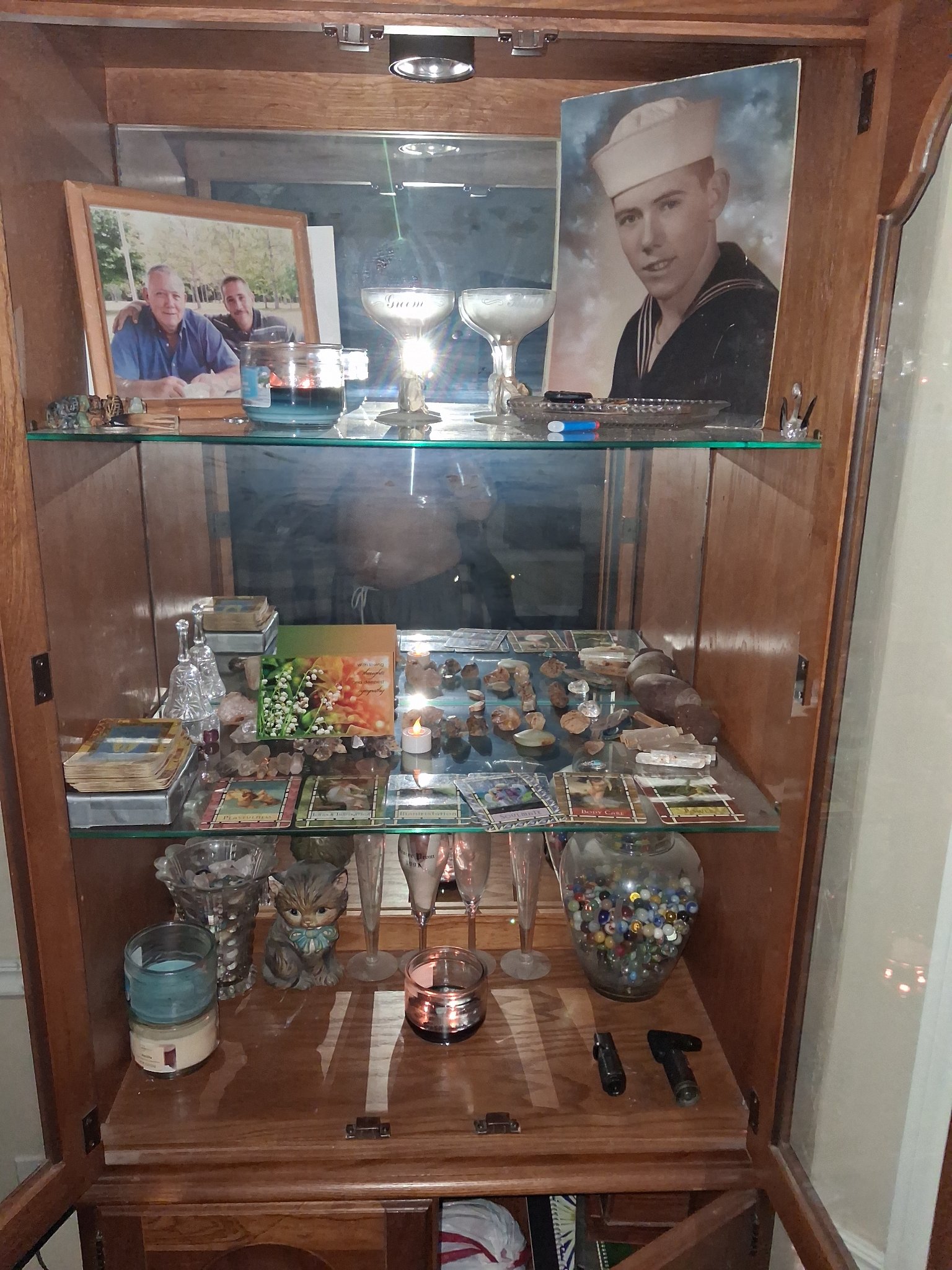
Update — November 7, 2026. One week after his death, Thomas Alan Bowman Sr.’s body has still not been collected or examined in full. The complete examination the VA offered on November 4 and the family accepted on November 5 sits with VA Risk Management; its answer is promised by Monday, November 9. In the early hours of November 7, the family sent that record to the Secretary and, by name, to his whole team (Letter No. 7). At home in Port Orange, he is honored: a memorial cabinet holds his Navy portrait and the photograph of father and son, and his son keeps candles lit in front of them.
Update — November 13, 2026. While the VA’s autopsy decision sat unanswered, the Department was calling the dead man’s own phone. In the early hours of November 13, Thomas found his father’s handset — kept nearby because his girlfriend’s own phone is not working — and scrolled its call list. Logged under “Department of Veterans Affairs” are at least four calls placed to the veteran’s own number after his death: two on November 6, one on November 9, and one on November 11, with the calls continuing back to about November 1. On November 11, the VA’s decedent-affairs office wrote to the family that it had attempted to reach them by phone. The family contact number the VA held for this case was not that handset; it was the Bowman Care Line, (386) 278-1896. The family’s second notice, sent November 12, gave the Department until November 13 to decline the autopsy in writing or claim the body. No decision came. The dates and the count are Thomas’s account, taken from the handset itself; no carrier log has been pulled, and the handset is being preserved as evidence.

Corrections
October 19, 2026 — A1c. This page, Letter No. 1, and the family’s filings stated that an A1c was “ordered three times and never drawn.” That is wrong, and it is withdrawn. The VA’s own chart (Blue Button report pulled August 24, 2026) contains drawn HGB A1C results: January 23, 2026 — 8.0; March 3, 2026 — 7.8; June 10, 2026 — 6.4 — improving from 9.2 in July 2024. Letter No. 1 stands exactly as mailed, as the record of what was sent; its A1c line is superseded by the chart. The diabetes charge that stands on documents is the conflicting basal-insulin orders (60 units against 5). The August 7, 2026 departure is stated above, with the family’s position.
Addendum — October 19, 2026 (attachments review). The VA’s own account is now in the family’s hands — the Orlando VA Medical Center Director’s consolidated letter to Sen. Scott (August 14, 2026) — and the receiving facility’s orders corroborate its endpoint: an appointment WAS booked for August 28, 2026 (08:30, AdventHealth Center for Interventional Endoscopy; Med-One transport booked; NPO from midnight). Any phrasing on this site implying no appointment was ever booked is corrected: a booking existed. What no record in the family’s hands shows is the recommended procedure — the March 11 advanced endoscopy and completion evaluation — being performed. That remains the charge. The same production adds to the diabetes record above: Beach Street’s orders ran glargine 40 units against the Shands ED home-medication list’s Lantus 80 units nightly, and Beach Street’s own labs drew an A1C of 7.4 on August 15, 2026.
October 19, 2026 — Consult #9247778. This page and Letter No. 1 stated the consult “was never scheduled.” The fuller record is worse, and more precise: VA surgeons recommended transfer for advanced endoscopy on March 11, 2026; the referral was recorded March 20, 2026; Community Care appointments were created in May and July 2026 and were scheduled, rebooked, and cancelled; the family was never given a working scheduled date for the recommended procedure; and the March 11, 2026 recommendation was never carried out. That sentence is the charge.
November 1, 2026 — Consult #9247778, this page’s offices table. The table above carried the superseded wording — the consult described as never scheduled. It has been aligned to the October 19, 2026 correction above: an appointment was booked for August 28, 2026; the March 11, 2026 recommendation was never carried out.
Facts on this page are drawn from the family's case file and the VA's own records as documented in it. Allegations are attributed; medical and legal identifiers are withheld by policy (see Legal).